

An eight-year fraud scheme. Two insiders who knew something was wrong. One qui tam lawsuit. A $21.3 million settlement — and a hard lesson for anyone who suspects their employer is gaming a federal contract.
On June 9, 2026, the U.S. Department of Justice announced that Broadway Electric Inc., Cornerstone Contracting Inc., and their CEO and president agreed to pay $21.3 million to resolve allegations that they spent years exploiting a federal program meant to help disabled veterans. The case is a useful, real-world illustration of how whistleblower law actually works — what the fraud looked like from the inside, how it unraveled, and why the people who blew the whistle ended up walking away with millions while the government recovered the rest.
What Actually Happened
According to the Department of Justice, federal contracting rules set aside certain contracts exclusively for Service-Disabled Veteran-Owned Small Businesses (SDVOSBs) — businesses that must be genuinely owned and controlled by veterans who were injured in service to the country. The program exists to give those veteran-owned companies a real shot at federal work that larger competitors can’t touch.
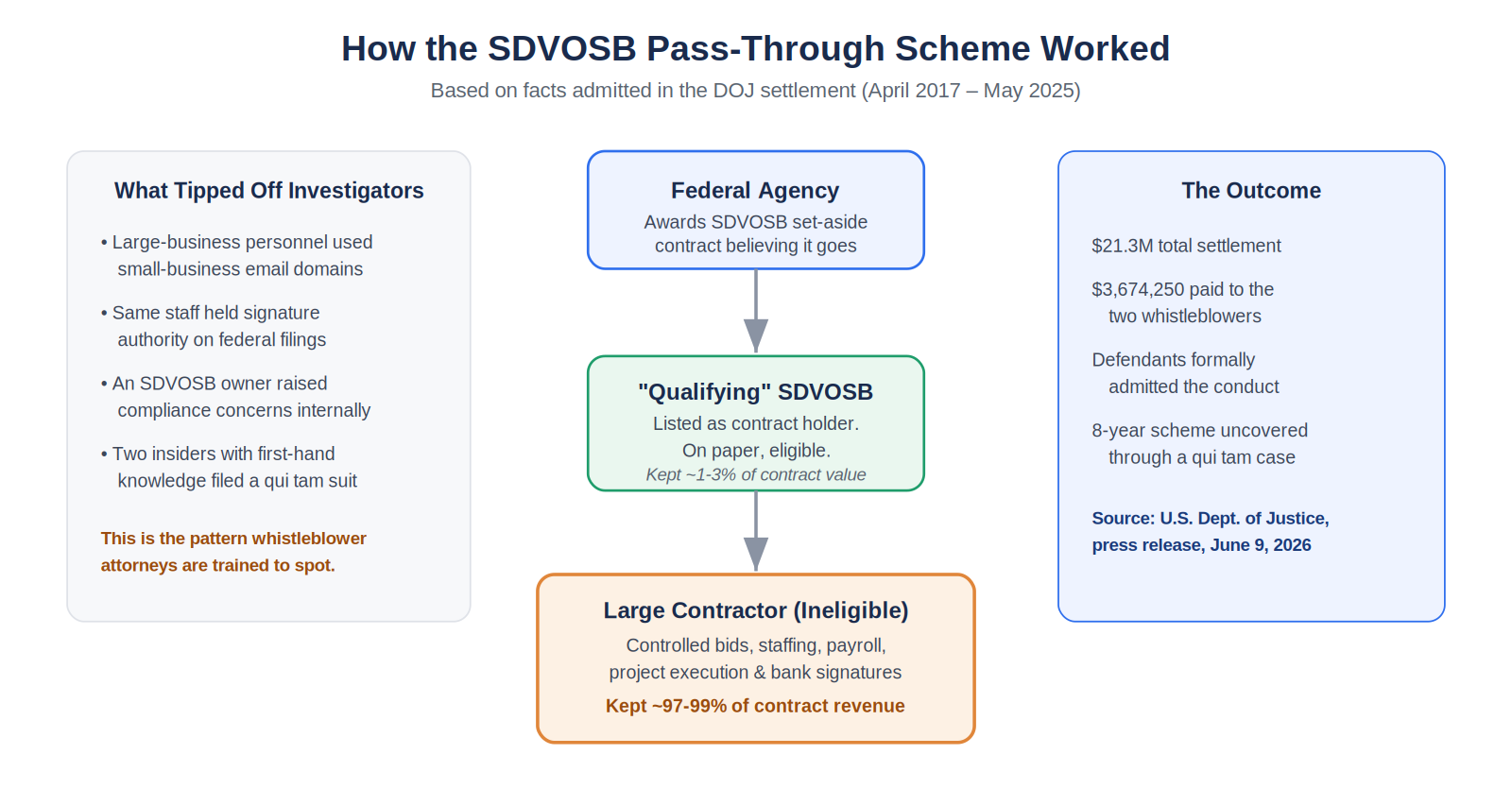
From approximately April 2017 through May 2025, prosecutors allege that Broadway and Cornerstone got around that rule entirely. Rather than competing for non-set-aside work, the companies allegedly used legitimate SDVOSBs and other qualifying small businesses as pass-through entities — fronts that appeared, on paper, to be running the contracts.
In reality, the Justice Department found that Broadway and Cornerstone personnel:
- Identified the contracting opportunities and prepared and priced the bids
- Secured the bonding needed to win the work
- Selected the subcontractors and personnel who actually performed it
- Controlled day-to-day project execution and financial administration, including payroll
- Used small-business email domains and held signature authority when communicating with federal agencies on the small business’s behalf
The supposedly independent SDVOSBs were paid a fixed fee — typically just 1% to 3% of the total contract value — with the rest of the money flowing back to Broadway, Cornerstone, and the contractors they picked. Neither the CEO nor the president of the two companies was a service-disabled veteran, and neither qualified to own or control a business under the program’s rules.
Notably, this wasn’t a case where the companies fought the allegations to the end. As part of the settlement, the defendants formally admitted, acknowledged, and accepted responsibility for the conduct — a more decisive resolution than the typical False Claims Act settlement, where companies often pay without admitting wrongdoing.
How It Came Apart
Schemes like this are notoriously hard for the government to catch from the outside. A contract file can look completely compliant — the right business name is on the paperwork, the certifications are current, the invoices go out on time. What’s much harder to fake over years of operation is who is actually making the decisions day to day.
That’s exactly what unraveled here. According to the settlement, at least one SDVOSB owner involved in the arrangement raised concerns about whether it complied with federal control and participation requirements — concerns the defendants didn’t act on. It was two people with first-hand knowledge of how the contracts really worked — one a veteran of the U.S. Air Force, the other an executive at an SDVOSB firm — who ultimately filed a qui tam lawsuit under the False Claims Act in the U.S. District Court for the Northern District of New York.
That single decision triggered a federal investigation that pulled in the Department of Veterans Affairs Office of Inspector General, the Defense Criminal Investigative Service, the Army Criminal Investigation Division, the General Services Administration Office of Inspector General, the Small Business Administration, and the U.S. Postal Inspection Service. Eight years of conduct, untangled because two people decided to come forward — and had legal counsel to help them do it the right way.
What the Whistleblowers Received
Under the False Claims Act, private individuals who file a qui tam suit on the government’s behalf are entitled to a share of whatever is recovered. In this case, the two relators will receive $3,674,250 — roughly 17% of the total settlement.
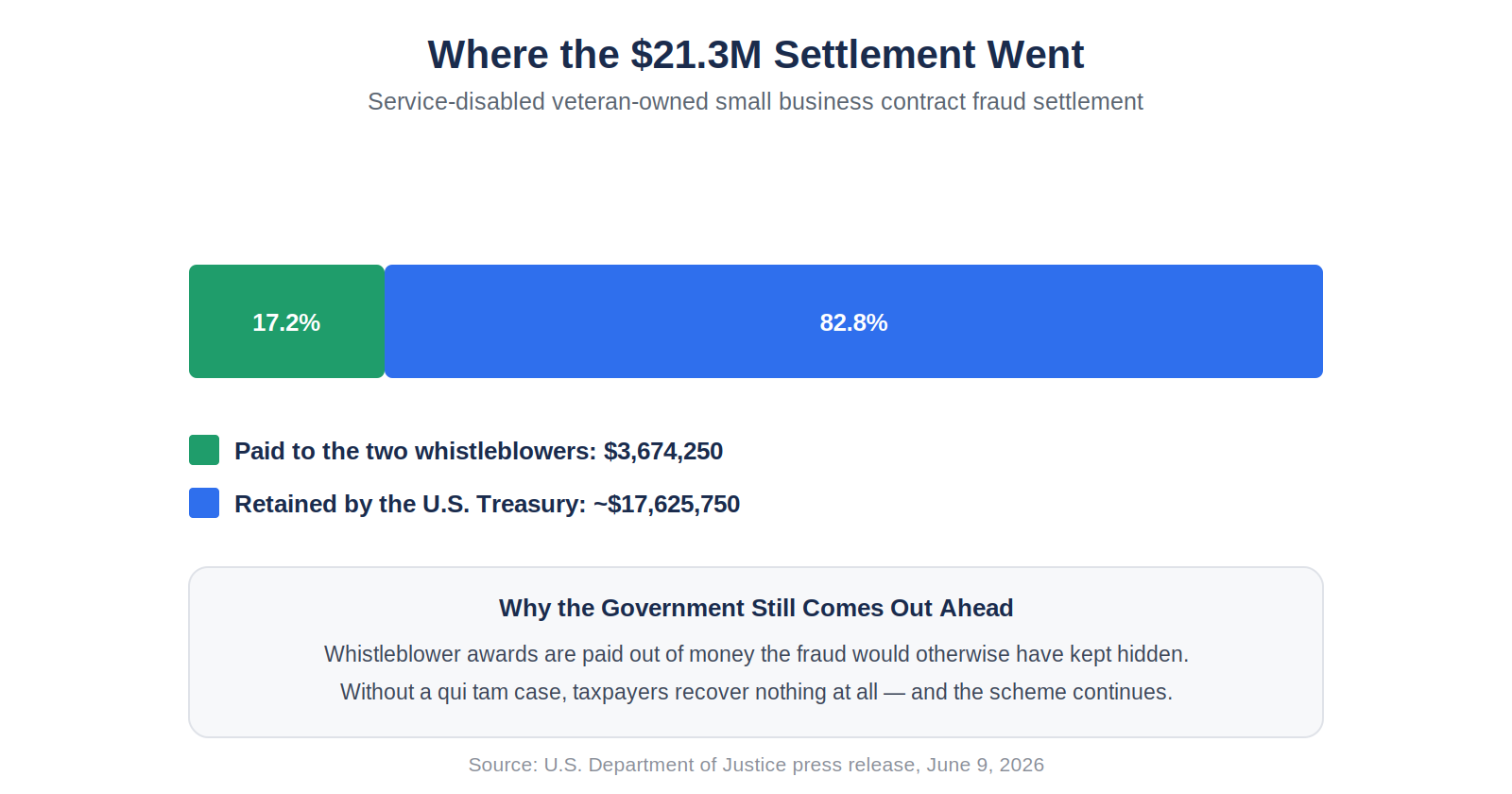
It’s worth sitting with that chart for a second, because it answers the objection people sometimes raise about whistleblower rewards — isn’t it unfair that the whistleblower gets paid? The honest answer is: the government still keeps the overwhelming majority of the recovery, and without the whistleblower, it likely would have recovered nothing at all. The fraud here ran for eight years before anyone with inside knowledge stepped forward. The reward exists because the law recognizes that insiders take on real risk to expose something the government otherwise can’t see.
Why This Case Is a Lesson in Hiring the Right Attorney — Not Just Any Attorney
It’s tempting to think a whistleblower case is mostly about having good evidence. In a case like this one, evidence wasn’t really the obstacle — it was knowing how to use it.
A few things about this case illustrate exactly where experienced whistleblower counsel earns its value:
- Recognizing the legal theory, not just the suspicious behavior. “My company seems to be cutting corners on a veteran contract” is a vague, hard-to-act-on feeling. “My company is using a pass-through structure that violates SDVOSB control requirements under the False Claims Act” is a legal theory the Department of Justice can actually investigate. Turning the first into the second is precisely what whistleblower attorneys are trained to do — they know what federal regulators are already looking for, which is part of why government enforcement priorities in this exact area (small-business set-aside fraud) have been increasing.
- Building a “who did what” case. Pass-through and control-fraud cases live or die on detailed, fact-specific investigation: who signed what, whose email domain sent which message, who controlled which bank account, who actually supervised the work on site. This isn’t theoretical — it’s exactly the kind of granular, document-heavy investigative work that separates a qui tam case that survives government scrutiny from one that gets dismissed early.
- Filing in the right place, under the right statute, before anyone else does. The False Claims Act operates under a strict first-to-file rule — generally, only the first relator to bring a claim based on a given set of facts can recover. Whistleblowers who wait, who report internally first and hope it gets fixed, or who don’t know which federal program applies to their situation can lose their claim before they ever file it.
- Protecting the whistleblower while the case is under seal. Qui tam cases are filed under seal, often for years, while the government investigates. Whistleblowers need guidance on what they can and can’t say — to coworkers, on social media, even to family — without jeopardizing the case or their own legal protections against retaliation.
- Coordinating with multiple federal agencies. This case pulled in six different federal offices. An experienced whistleblower attorney knows how qui tam cases move through the Department of Justice and which inspector general offices are likely to get involved based on the facts — which affects how a case gets framed and presented from the very first filing.
If Something Like This Looks Familiar to You
Pass-through arrangements, inflated small-business participation, and control fraud aren’t limited to one industry or one kind of federal contract. The pattern in this case — a small, “eligible” business on paper, while a larger ineligible company actually runs the show — shows up across construction, IT services, professional services, and defense contracting alike.
If you’ve noticed:
- A small business or veteran-owned entity that doesn’t seem to actually control the contract it’s listed on
- Staff from a large company using a small business’s email domain or signing on its behalf
- Bid preparation, staffing, or financial decisions being made by people outside the company that’s supposed to be eligible
- Concerns you’ve raised internally that got brushed aside
It’s worth having a confidential conversation with a whistleblower attorney before you do anything else. As this case shows, the people who came forward didn’t just expose a fraud — they helped recover more than $21 million for taxpayers and were rewarded for the risk they took in doing so.
This article is provided for general informational purposes only and does not constitute legal advice. The settlement described resolved allegations; except where the defendants expressly admitted specific conduct as part of the settlement agreement, the allegations do not constitute a finding of liability. No attorney-client relationship is formed by reading this content. If you have information about possible fraud involving federal contracts, programs, or funds, contact our office for a confidential consultation.